

TEDx (GlobaL)thought leadershipoct 2023TEDx - How Climate Change Creates Ingenuity
[ OVERVIEW ]Giselle Carr inspires us to embrace the immensity of climate change so that we can work to find innovative ways to address it. In her talk at TEDxPortofSpain Women 2023 she showed how complex problems have been solved by human ingenuity, creativity, and innovation. She encourages us to let the scale of the climate change problem dissolve our mediocrity. Will you take the challenge? Giselle is a Design Strategist who has worked primarily in design, marketing and brand strategy, creating environmental, social and economic value for a variety of brands.
Case Study Details - TEDxPortofSpain
Goal
Inspire and inform about climate change
Over 156,000 views (top 5%)
Results
An Idea Worth Spreading
After more than 156,000 views, this talk continues to bring CDR to new audiences.
After more than 156,000 views, this talk continues to introduce new audiences to carbon removal, regenerative climate solutions, and a more expansive way of thinking about our role in the climate story. It reframes climate change not only as a crisis to be solved, but as a profound invitation — to innovate, to collaborate, and to reconnect with humanity’s capacity to design a future rooted in care, courage, and creativity.
[ HIGHLIGHTS ]Falling in love with the immensity of climate change.
Embracing Immensity
Climate change is often framed as overwhelming — too big, too complex, too frightening to fully confront. In this talk, I invite audiences to do the opposite: to lean into the immensity of the challenge rather than turning away from it. When we allow ourselves to truly acknowledge the scale of what’s unfolding, we unlock a deeper capacity for imagination, courage, and creativity. Immensity, when met with honesty, becomes a catalyst — not for despair, but for transformation.
Human Ingenuity at Work
Throughout history, humanity has consistently risen to its greatest challenges through ingenuity. From technological breakthroughs to social innovation, moments of crisis have often sparked our most meaningful leaps forward. This talk situates climate change within that lineage — not as an anomaly, but as the defining design challenge of our time. By reconnecting with our creative intelligence and collaborative instincts, we can move beyond paralysis and rediscover our role as active problem-solvers in service of life.
CO2 Removal and Regenerative Solutions
Addressing climate change requires more than reducing emissions — it demands regenerative solutions that actively restore balance to Earth’s systems. The talk introduces carbon dioxide removal (CDR) as one such frontier, highlighting how science, ecology, and human ingenuity can converge to repair what has been damaged. Rather than positioning technology and nature as opposing forces, it reframes them as collaborators — working together to regenerate soils, rebalance ecosystems, and support long-term planetary resilience.
Rewriting the Climate Narrative
Perhaps the most urgent work of our time is narrative work. Climate discourse has long been dominated by fear, guilt, and inevitability — narratives that can unintentionally disempower. This talk challenges that framing, offering a shift from doom to possibility, from extraction to regeneration, from spectatorship to agency. By rewriting how we talk about climate change, we expand who feels invited to participate — and what futures we collectively believe are still possible.
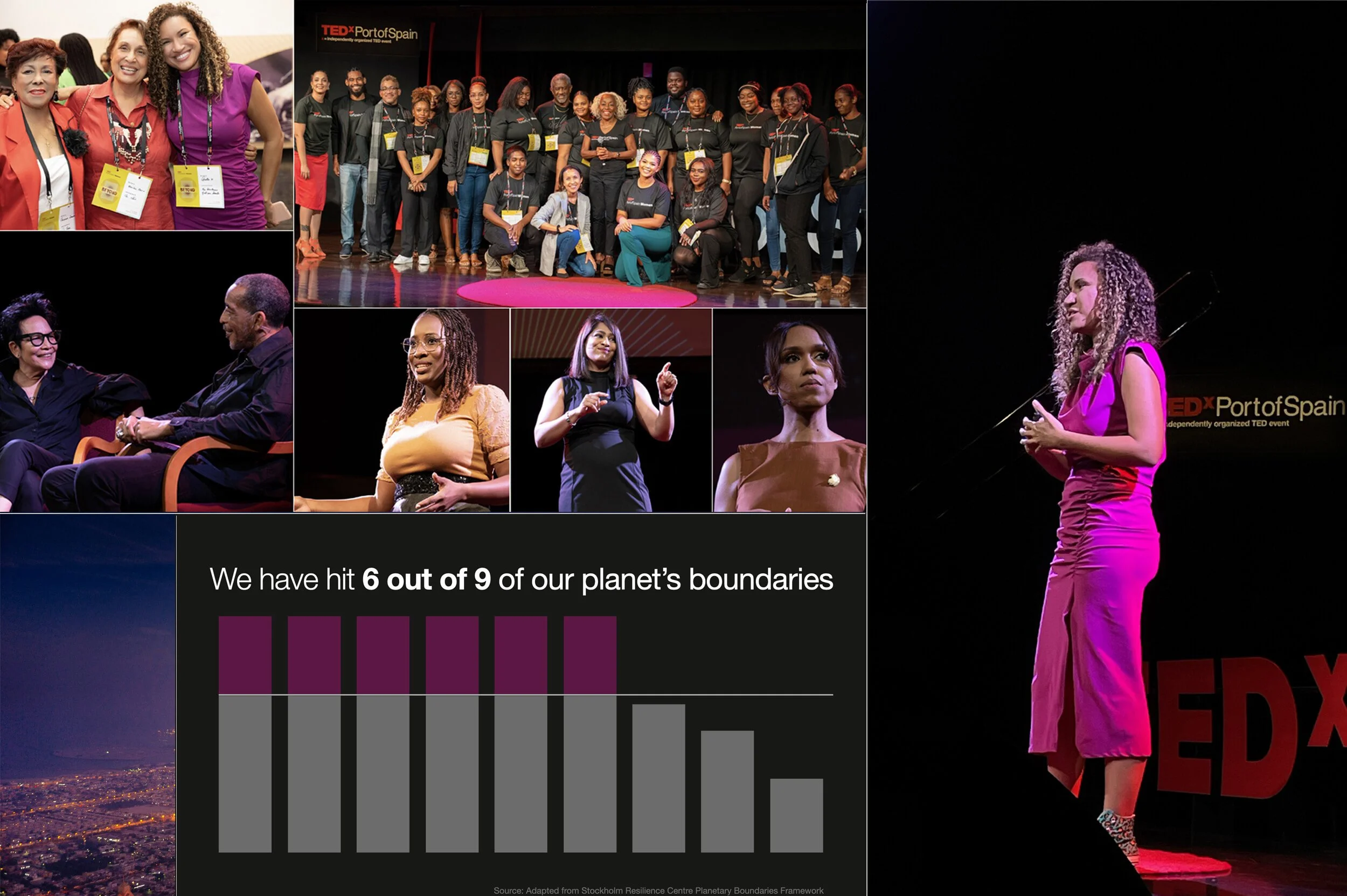
IMAGE CREDIT: PHOTOGRAPHY COURTESY TEDXPORTOFSPAINUnderstanding the data in the talk: planetary boundaries and Earth’s interdependent conditions
The planetary boundaries framework, developed by the Stockholm Resilience Centre, identifies nine Earth system processes that together regulate planetary stability. At the time of this talk, six boundaries had already been crossed. As of 2025, seven have now been exceeded — signaling escalating systemic risk across climate, ecosystems, and human wellbeing.
-
For nearly 12,000 years, Earth existed in a remarkably stable state known as the Holocene — the climatic window that allowed agriculture, cities, and complex societies to emerge. This stability was not accidental, but the result of tightly interwoven systems regulating temperature, water cycles, biodiversity, and atmospheric chemistry. The planetary boundaries framework shows how recent human activity has disrupted this balance. When six of nine boundaries had been crossed at the time of this talk — and seven by 2025 — it marked a departure from conditions that once reliably supported human civilization.
-
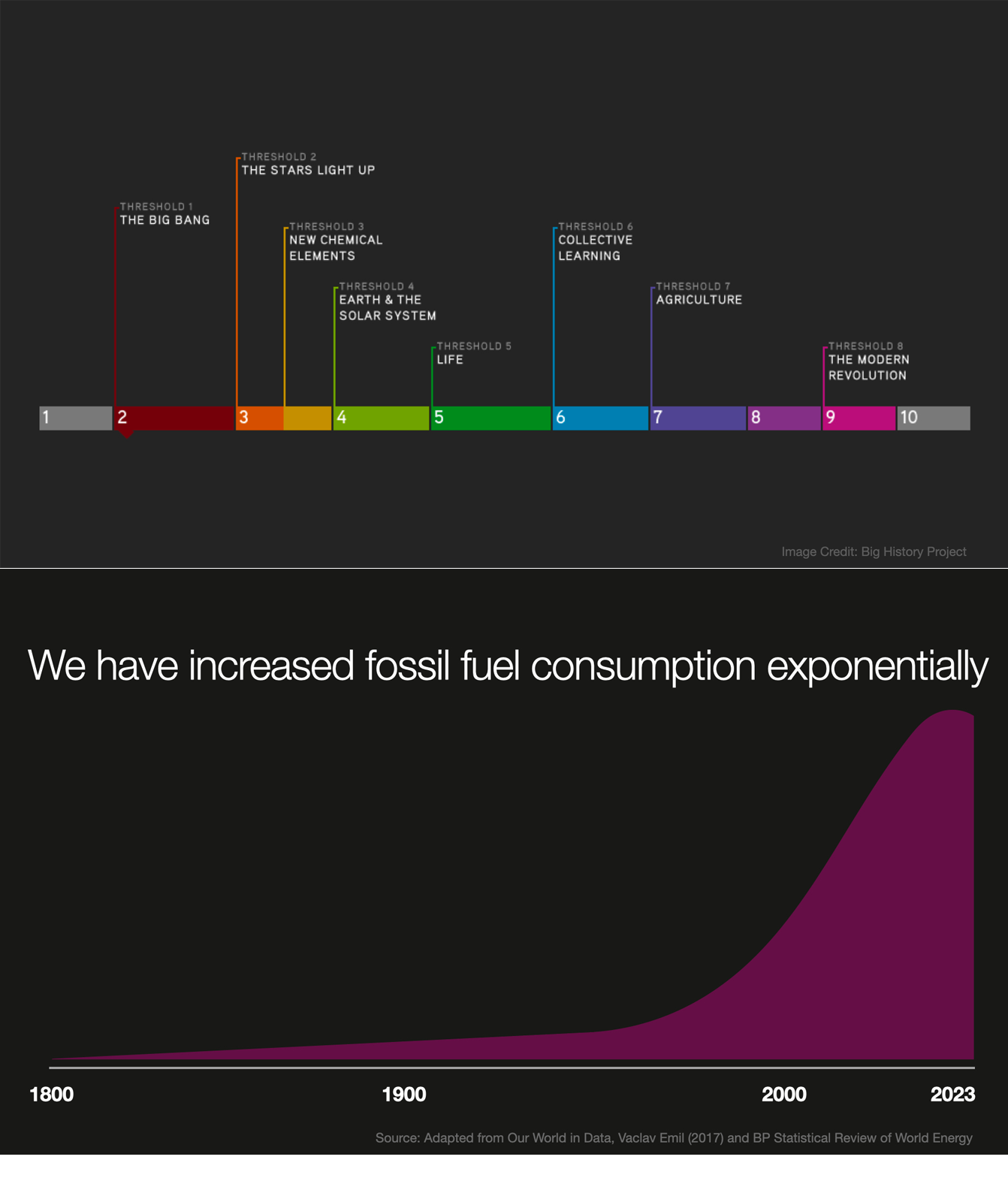
Carbon dioxide emissions sit at the heart of the climate boundary — and ripple outward into many others. Excess CO₂ traps heat, destabilizing climate systems, warming oceans, and intensifying extreme weather. It also drives ocean acidification and weakens biosphere resilience. In the talk, carbon emissions are framed not as an isolated metric, but as a systemic force. The progression from six crossed planetary boundaries to seven underscores that continued emissions compound risk, pushing Earth further from the stable operating space on which life — and economies — depend.
■
The problem is immense, which means that our response must be too.
Why this matters now.
We are living through a pivotal decade — one where delay, distraction, and incrementalism carry real consequences. As climate risk accelerates, so must our capacity to think systemically, act boldly, and design beyond short-term incentives. This moment demands leadership that is imaginative, interdisciplinary, and deeply accountable to life itself.
Dissolving mediocrity.
Climate change exposes the limits of surface-level solutions and comfortable thinking. This talk calls for dissolving mediocrity — moving past safe narratives, half-measures, and recycled ideas — in favor of courageous creativity and rigorous innovation. The future will not be shaped by adequacy, but by those willing to imagine and build what has never existed before.